

These two hot and spicy peppers that were both once at the top of the world in terms of spiciness. And as they vied for the top spot, there’s naturally an interest for the scorpion pepper vs Carolina reaper comparison.
Before we get into that, let’s have some clarification on what the “scorpion pepper” of note should be. There are a few peppers that can classify as “scorpion pepper”.
But since this comparison is with the famed hot Carolina reaper, the chosen pick has to be Trinidad Moruga Scorpion – the hottest of these peppers and the one suited to compare with the famed Carolina pepper.
Though heat and spiciness are the key qualities we use for looking at chili peppers, this comparison will also discuss other qualities like flavor, origins, texture, etc. So, let’s get started!
Table of Contents
Carolina Reaper VS Scorpion Pepper – Key Points
Which Pepper Carries More Heat Between Carolina Reaper And Trinidad Moruga Scorpion Pepper
Short answer: Carolina reaper is the hotter chili.
At different points of time, both Carolina Reaper and Trinidad Moruga Scorpion have held the title of being the hottest chili in the world.
Trinidad Moruga Scorpion pepper made its way into the Guinness World Records in 2011 by being crowned as the hottest chili pepper in the world. It dethroned the famous Ghost Pepper, which had held the top spot for a long time unofficially, but officially since 2007.
However, the crown is fickle, and moved to the Carolina Reaper in 2013 as the hottest chili pepper.
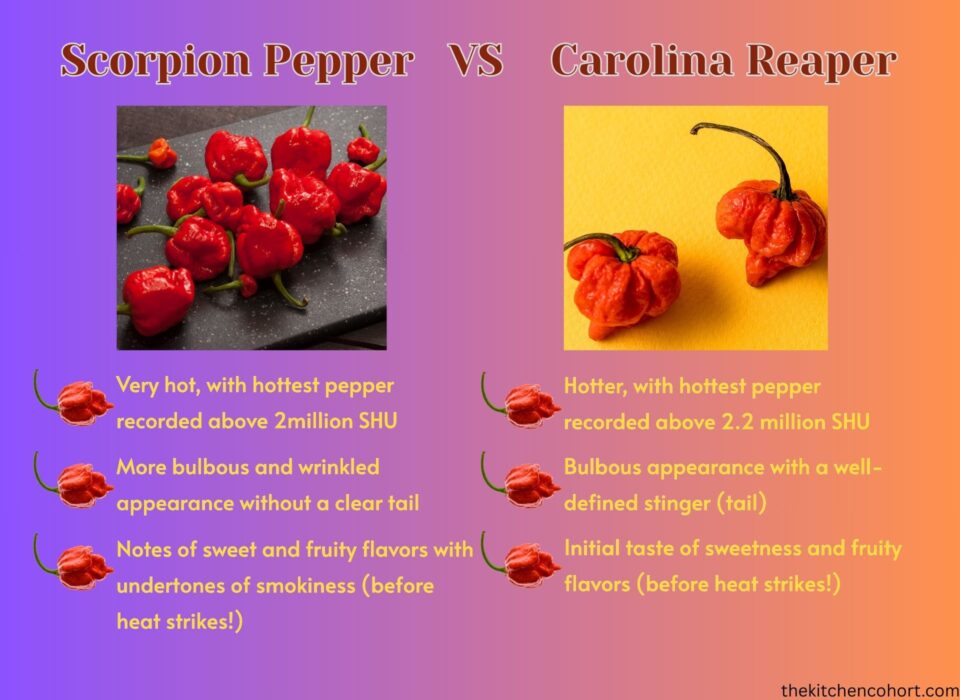
Trinidad Moruga Scorpion pepper averages at around 1.2 million SHU (Scoville Heat Units), with the hottest recorded at just a little over 2 million SHU. Carolina Reaper averages at 1,641,000 SHU, with the hottest pepper recorded at 2.2 million SHU.
For comparison, the average green chili pepper ranges from 1000 to 8000 SHU. Even the Serrano pepper, conventionally known for being very hot tops out at 23,000 SHU.
The Origins Of Carolina Reaper And Trinidad Moruga Scorpion Pepper
Carolina Reaper was developed by Ed Currie by crossing ghost pepper and Saint Vincent Habanero peppers
The Trinidad Moruga Scorpion Pepper has more of a colorful origin as there are several famed scorpion peppers, each known for their heat. In this case, the name Moruga refers to the village in Trinidad where this pepper was first cultivated. Incidentally, it is hotter than its sibling, the Scorpion Butch T pepper, which is another famed hot chili from the same region.
Shape And Aesthetics – Scorpion Pepper vs Carolina Reaper
Carolina reaper has a distinct shape, showing up as a red, bumpy blob, complete with an ominous tail or stinger at its end.
The scorpion pepper has a more wrinkled appearance and a less defined tail compared to the Carolina reaper. It also has a somewhat more bulbous appearance.
Flavors Of Note
While heat and spiciness are all the reasons for the fame of these super hot peppers, their flavors are not to be underestimated! These chilies present something of a slow burn. When someone bites into them, often heat is not the first to register its presence. It builds up slowly and sometimes can take several seconds – even up to a minute to fully register its presence.
So the flavors with the first bite are worthy of note.
Scorpion pepper brings a fruity and sweet flavor, with undertones of smokiness. Carolina reaper feels sweeter and has a nice touch of fruity flavors.
Of course, all that comes right before the full heat builds up and kicks in!
Yet, it doesn’t mean that these flavor notes and qualities go to waste. They are generally well employed in commercial use, with many salsa, soups, and similar preparations taking advantage of the deep flavors and the spicy hotness.
It’s rather rare for these peppers to be available for home use. Some enthusiasts do use them, but for the general public, there isn’t much sense working with such hot chili peppers. Remember, working with these uber hot peppers involves protection for hands, eyes, and even the surfaces in contact with the peppers.
So, it’s a better idea not to save ourselves the trouble and not use these peppers at home.